You’ve probably heard the number that hurts every infertile couple: even at the world’s top fertility clinics, IVF success rates typically range between 20% and 40% per round. That figure can be disheartening for couples who see IVF as their last hope after months or years of trying to conceive. To increase your chances of success, however, you must first understand the Hidden Reasons IVF Fails.
IVF failure is rarely random, according to Dr. I. S. Yakub of Well Life Hospital. Sperm quality, egg quality, embryo quality, and the womb environment are the four main factors responsible in most cases. The three aspects that start before the baby ever enters the womb, sperm, egg, and embryo quality, are what couples can actually do about them, and will be the main topics of this article. Understanding these Reasons for unsuccessful IVF can help couples make more informed decisions throughout their fertility journey.
The Sperm Factor: Why “Normal” Outcomes Don’t Tell the Whole Story
A seminal fluid examination, which verifies general characteristics such as sperm count, motility, and morphology, is the first step in every IVF cycle. When these figures fall within the range, couples are often told that their sperm quality is “good.” However, a typical semen study provides only part of the picture.
The quality of the sperm’s DNA, which is a much stronger indicator of how effectively an embryo would function following fertilization, is what it does not disclose. The Sperm DNA Fragmentation Index (DFI) test quantifies this. Even if the sperm seem structurally normal under a microscope, DFI increases above 15% and represents a substantial risk factor for IVF failure. This is one of the Hidden Reasons IVF fails that is frequently overlooked during routine fertility assessments.
Several commonplace elements can subtly harm sperm DNA and reduce sperm quality overall:
- Alcohol and cigarettes have been shown to lower sperm motility, morphology, and count.
- Obesity is a lifestyle factor that lowers sperm quality.
- Prolonged sitting: Sperm production can be harmed by anything that raises testicular temperature, such as driving and wearing tight underwear.
- Blood trapped by varicoceles: varicose veins surrounding the testicles, which raise the local temperature and degrade sperm quality. They can be seen on ultrasonography, and surgical correction frequently results in quantifiable improvement.
Exposure to environmental toxins: Workplace exposure to chemicals such as lead (from gasoline fumes) or pesticides has been associated with steadily decreasing sperm parameters. After years of fume exposure, a gas station manager’s sperm count fell to zero in one reported clinical case; however, it returned to normal following a work change and six months of therapy.
The lesson is that men getting ready for IVF, particularly those with a known male-factor diagnosis, should actively cut back on unhealthy lifestyle choices and ask their clinic for DNA fragmentation testing rather than just a regular semen study.
The Egg Factor: Why Age Is More Important Than Nearly Everything Else
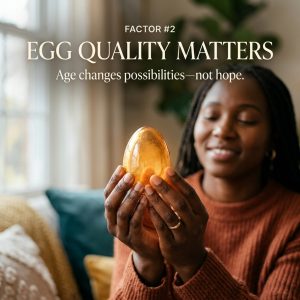
The fact that a woman does not create new eggs over her lifetime is one that every woman thinking about IVF should grasp. Since she was born with every egg she will ever have, her eggs age in tandem with her and eventually sustain the same amount of cellular damage.
IVF success rates are directly and quantifiably impacted by this:
- A woman’s odds of IVF success are usually higher than 45% if she is under 35.
- Success rates can drop to 10% for those over 40, mostly as a result of deteriorating egg quality.
This is particularly significant because of a finding that completely changes the conversation: when a 40-year-old woman uses donor eggs from a woman under 35, her IVF success rate jumps back up to over 45%. This tells us something crucial: the age and quality of the eggs being used determine outcomes, not the woman’s age itself.
For this reason, fertility specialists advise women to begin their fertility journey early rather than waiting until obstacles force them into treatment later in life. Additionally, egg donation is presented as a valid, evidence-based way to improve success rates for women whose egg quality has been compromised due to age or other factors.
Beyond age, environmental exposure also affects egg health, including exposure to toxins through specific skincare products, an often-overlooked factor that can gradually affect egg quality. The conclusion is that the single biggest factor influencing women’s success with IVF is egg quality, not effort, lifestyle perfection, or hope; if your egg quality is compromised, donor eggs aren’t a failure; they’re a strategy. These are among the most important Reasons for unsuccessful IVF that fertility specialists discuss with patients.
The Embryo Factor: The Reasons Why Even “Grade A” Embryos Can Fail
A physical grading system, such as Grade A, Grade 1, and so on, is used to evaluate the developing embryo after the sperm and egg unite. Higher-grade embryos typically have better odds of being implanted. The unsettling reality is that physical grading only reveals the embryo’s appearance, not its functionality.
Similar to a person who appears healthy on the exterior but has an underlying sickness, an embryo can have genetic abnormalities that are unseen to the unaided eye, even though it appears structurally perfect under a microscope. This explains why sometimes Grade A or Grade 1 embryos do not implant.
Pre-Implantation Genetic Testing (PGT), a procedure that examines the embryo’s DNA directly rather than just its appearance, is now available in many clinics to close this gap. As of right now, this is the most accurate method for determining if an embryo is likely to produce a live baby rather than just a positive pregnancy test.
Additionally, it’s crucial to keep in mind that an IVF “success” is a live birth rather than a positive pregnancy test. This distinction is important since a pregnancy’s progression or early loss is frequently determined by the quality of the embryo. The quality of the sperm and egg utilized to generate the embryo ultimately determines the embryo’s quality. Because of this, addressing male and female issues at the beginning of the process has a cascading influence on all subsequent stages of treatment. This explains some of the Hidden Reasons IVF fails, even when embryos appear healthy.
Conclusion
IVF failure is typically caused by identified, frequently fixable conditions rather than bad luck or a “weak” body:
- Sperm quality is more than just basic semen analysis numbers; it includes DNA fragmentation.
- Egg quality is essentially correlated with age rather than just overall health.
- Embryo quality grading alone is insufficient; genetic testing can improve, which is dependent on both of the aforementioned contributing variables.
Asking thoughtful questions is the most empowering thing you can do when getting ready for IVF: Has fragmentation of DNA been examined? What is the realistic prognosis given the age and quality of the eggs? Should the embryos be subjected to genetic testing? Your chances of leaving with a healthy child rather than merely a broken cycle are increased by these discussions, not just hope. Understanding the **Reasons for unsuccessful IVF** empowers couples to take proactive steps that can improve their chances of achieving a successful pregnancy.
Under the direction of Dr. I. S. Yakub, Medical Director, Well Life Hospital, situated in Wuse 2, Abuja, provides complete fertility and IVF services. Contact our staff to find